
Digital Energy in Practice: What Is Actually Worth Implementing?
Digitalisation is already changing the energy sector, but the difficult part is no longer finding new technology. It is deciding what is worth implementing, what actually improves operations and where digital solutions create measurable business value. These are the questions at the heart of the EU Regional Digital Energy Summit ’26 in Ljubljana on 2–3 December 2026.
A few years ago, much of the discussion around digital energy was still about what might become possible.
Today, many of those technologies are already here.
AI is moving into utility operations. Digital twins are being used in real systems. Buildings are becoming more active parts of the energy system. Flexibility is growing in importance. Data centres are creating new demand, but also new opportunities around heat and sector coupling.
So the conversation has changed.
The question is no longer simply what technology can do.
It is much more practical:
What is actually worth implementing?
And perhaps just as importantly: what does not make sense yet?
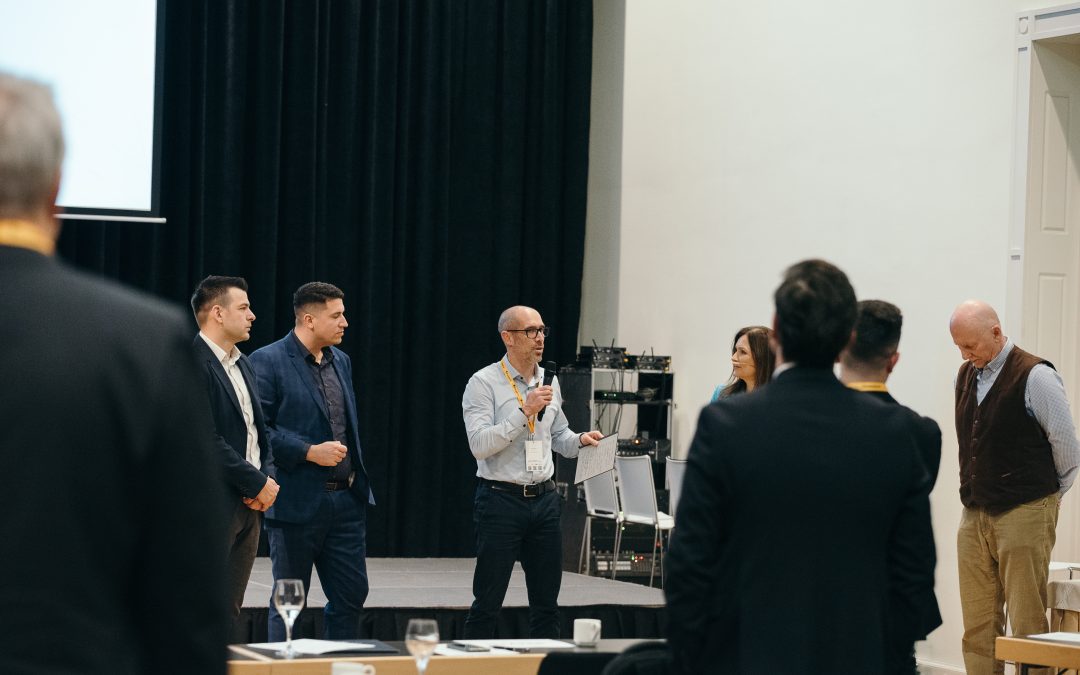
That was already very clear at last year’s EU Regional Digital Energy Summit in Ljubljana.
The strongest discussions were not about technology in isolation. They were about what happens when companies actually try to use it.

AI-ready grids start with data
AI gets a lot of attention in energy.
But when Gregor Taljan from Energienetze Steiermark GmbH spoke about AI-ready grids at last year’s Summit, he started somewhere much less glamorous:
data.
Many grid companies still work with separate data sources and systems that do not communicate well with one another.
If those foundations are not in place, AI will not solve the problem for you.
Taljan also made another important point: before introducing AI, companies should know exactly what they want to use it for.
What is the use case?
What should improve?
What do we actually want to get out of the system? Izjave govorcev transkript
That is probably one of the most useful distinctions in digitalisation today.
Technology should follow the problem.
Not the other way around.
Industrial AI is already moving into real operations
One of the examples presented last year came from Petre Bozhikov from craftworks GmbH.
His team showed an industrial AI application used to optimise electricity production in Austria, including optimisation of flow rates across river systems.
The aim was very concrete: use AI to improve the production process and make electricity generation more efficient. Izjave govorcev transkript
That is where AI becomes interesting for energy companies.
Not when it is presented as something futuristic.
But when it improves an existing process.

Digitalisation does not always mean replacing everything
Another useful example came from Alan Hadžić from SmartIS d.o.o.
He presented Smart Twin, a digital twin platform that can collect data from existing systems and sensors without requiring companies to replace the infrastructure they already have.
The logic is straightforward.
First, understand what is happening in the system.
Then use the data to understand how it behaves.
Only after that does it make sense to add more intelligence and optimisation. Izjave govorcev transkript
This matters because many organisations still associate digital transformation with large replacement projects.
In reality, some of the most useful steps may come from using existing infrastructure better.
Data centres also create heat
Data centres are becoming one of the biggest new energy topics.
Most of the discussion naturally focuses on how much electricity they use.
But Vojtěch Vavřička from ORGREZ TRADE, s.r.o. brought up another side of the story.
Data centres also produce large amounts of heat.
Instead of simply losing that heat, it can be connected with district heating systems. Heat pumps can raise the temperature and make that energy useful elsewhere.
That can improve efficiency, but it can also create a new revenue stream. Izjave govorcev transkript
This is a good example of where some of the more interesting opportunities are emerging today.
Not necessarily inside one technology, but between systems that used to be treated separately.
Buildings are becoming part of the energy system
Dr Miha Bobič from Danfoss Trata made a similar point from another angle.
He highlighted the fact that electricity and heat are still too often discussed separately.
At DES, those sectors meet in the same conversation.
“This is a unique conference where both electricity and heat sectors are together.”
That connection matters for grid flexibility, heating stability and the future development of both systems. Izjave govorcev transkript
And this is becoming more relevant every year.
Electricity increasingly interacts with heating, buildings, industry, data centres and storage.
The boundaries between sectors are becoming less clear.
The difficult part is often not the technology
Jožek Gruškovnjak from SAP Switzerland brought the discussion back to something very practical: change inside organisations.
One of the mistakes he sees is that companies become interested in a technology first and only afterwards start looking for the problem it should solve.
His advice was simpler.
Be clear about why the change is needed.
Make a plan.
Explain the benefit to the people who will actually have to work differently.
And do not spend all your energy on the small group that will resist any change anyway. Izjave govorcev transkript
That may be less exciting than talking about AI.
But it is often what determines whether a digital project works or not.
Why people still come to events like DES
There is another side to this.
Most of the information companies need is available online.
Reports, webinars, research, product presentations — there is no shortage of content.
So why still meet in person?
Gregor Taljan gave a very practical answer.
Grid operators across Europe often face similar challenges, but their solutions can be very different. Meeting others gives you the chance to compare approaches and see what is happening outside your own market.
It can also lead to partners for new projects and R&D cooperation. Izjave govorcev transkript
Jožek Gruškovnjak put it even more simply:
“We don’t learn in silos — we learn as a community.” Izjave govorcev transkript
And Martin Feder from Schneider Electric focused on the part that is difficult to plan in advance:
“There’s always something new that you take away — a different perspective.” Izjave govorcev transkript
Sometimes that is the most useful outcome.
A conversation with someone approaching the same problem differently.
A possible partner.
A new idea.
Or simply confirmation that you are asking the right question.
What comes next at DES ’26
The 5th EU Regional Digital Energy Summit returns to Ljubljana on 2–3 December 2026.
The programme will again sit at the intersection of energy, technology and industry.
AI and automation, data, digital grids, flexibility, battery storage, management systems, cybersecurity, digital platforms, data centres and new business models will all be part of the discussion.
But the point is not to collect as many technology topics as possible.
The more useful questions are much simpler.
What is working already?
Where are companies actually seeing results?
What is worth scaling?
And what should they wait with?
That is the direction DES ’26 is taking.
Digitalisation is not the goal
The energy sector does not need more technology for the sake of having more technology.
It needs solutions that make operations better.
That improve flexibility.
Help people make better decisions.
Reduce costs.
Create new business opportunities.
And work in the real world, with real infrastructure and real organisations.
That is probably the most important shift in the digital energy conversation today.
Less:
What can this technology do?
More:
What problem are we trying to solve?
EU Regional Digital Energy Summit ’26
2–3 December 2026 | Ljubljana, Slovenia
Where energy meets digital innovation.
What is the EU Regional Digital Energy Summit?
The EU Regional Digital Energy Summit is an international business event focused on practical digital transformation in energy. It connects energy companies, utilities, technology providers, industry and digital innovators around real projects, implementation and business value.
When will DES ’26 take place?
The 5th EU Regional Digital Energy Summit ’26 will take place on 2–3 December 2026 in Ljubljana, Slovenia.
What topics will be discussed?
The programme covers areas including artificial intelligence, automation, data and analytics, digital grids, flexibility, battery energy storage, management systems, cybersecurity, digital platforms, industrial electrification, data centres and new business models.
Who is DES intended for?
DES is relevant for energy companies, utilities, TSO and DSO organisations, industry, technology providers, AI and software companies, cybersecurity specialists, system integrators and other organisations working at the intersection of energy and digitalisation.
Why are real use cases important at DES?
Because they show what happens after the technology leaves the presentation slide: what was actually implemented, what problem it solved and what others can learn from the experience.